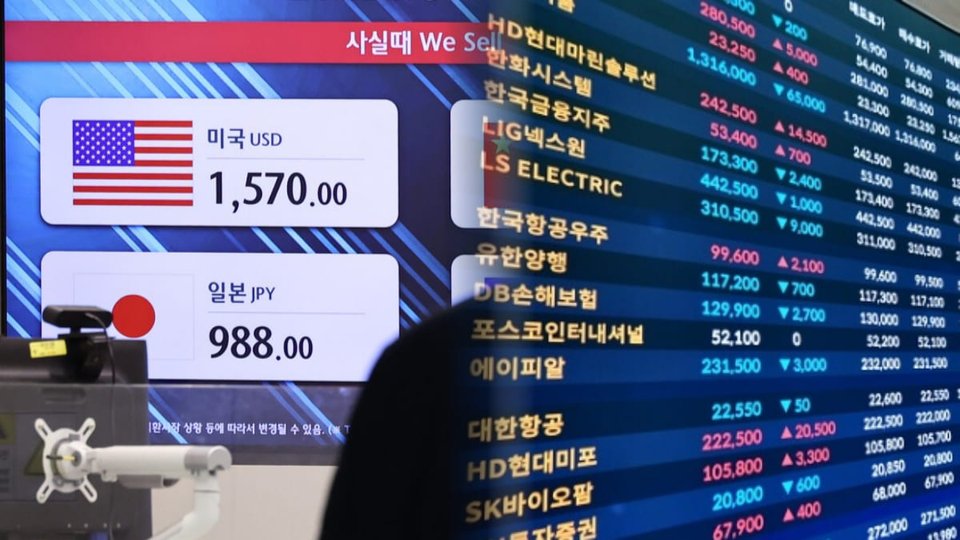
Rising Middle East Tensions: Won-Dollar Exchange Rate Surpasses 1,510 Won, KOSPI Plunges – A Key Overview
인포바이브 편집팀|입력 2026.03.23 06:14|0
사진 출처: 온라인 커뮤니티
Domestic Financial Market Hit Hard by Middle East Tensions
The domestic financial market has recently faced an unexpected variable – the escalation of military tensions in the Middle East – leading to significant volatility. Particularly on the 23rd, the Won-Dollar exchange rate surged and the KOSPI index plummeted, exhibiting what is known as 'panic selling,' which has heightened investor concerns. This serves as another reminder of the profound impact international instability can have on the domestic economy.
Geopolitical risks in the Middle East are exerting upward pressure on international oil prices, which in turn amplifies inflation concerns. As global economic uncertainty grows, the preference for safe-haven assets strengthens, leading to a vicious cycle of a stronger dollar and a weaker domestic stock market.
These complex factors, acting in concert, have delivered a significant shock to the domestic financial market in a short period. The surge in the exchange rate and the stock market crash are not merely numerical changes; they can lead to widespread economic ripple effects, such as dampened corporate investment sentiment and reduced household purchasing power, thus requiring close observation.
Won-Dollar Exchange Rate Surpasses 1,510 Won, Reaching a 17-Year High
In the Seoul foreign exchange market, the Won-Dollar exchange rate recently broke through the 1,510 won mark, which had been considered a psychological resistance level, reaching its highest point in 17 years. This level is reportedly similar to the high exchange rates seen during the 2009 global financial crisis, intensifying anxiety among market participants. The exchange rate started at 1,504.9 won, higher than the previous trading day, and reportedly continued to widen its gains throughout the day.
One of the primary reasons for the sharp rise in the exchange rate is the flight of capital to safe-haven assets. As concerns about surging international oil prices spread due to instability in the Middle East, investors tend to favor dollar assets, which are perceived as relatively safe. This increases demand for the dollar, raising its value, and conversely, causing the Korean Won to depreciate.
Furthermore, rising international oil prices exacerbate inflationary pressures, which is likely to reinforce central banks' policies of prolonged high interest rates. A high-interest-rate environment slows overall economic growth and dampens investment sentiment, acting as a factor for foreign capital to exit emerging markets, thereby further fueling the rise in the exchange rate.
KOSPI Plunges Over 6% and 'Sidecar' Triggered
The domestic stock market also experienced a shocking plunge alongside the surging exchange rate. The KOSPI index reportedly plummeted by over 6% compared to the previous day, hitting a new year-low. Specifically, at around 9:18 AM, the Korea Exchange triggered a 'sidecar,' temporarily halting program selling orders, as the KOSPI 200 Futures Index fell by more than 5%.
A 'sidecar' is a mechanism triggered in the stock market to mitigate market shocks when stock prices fluctuate sharply. It refers to the temporary suspension of program trading in the spot market for 5 minutes if futures prices experience extreme fluctuations. This measure is known to provide investors with time for calm judgment and prevent further chaos during periods of market overheating or sharp declines.
Despite the activation of the sidecar, the market's downward trend did not easily abate. The KOSPI index continued its significant decline at one point during the day, fueling investor anxiety. This sharp drop is interpreted as the market's sensitive reaction to external geopolitical risks and global economic uncertainty, rather than a reflection of domestic companies' fundamentals.
Foreign and Institutional Selling Spree and Individual Investor Response
One of the main causes of this stock market crash was the massive selling by foreign and institutional investors. They offloaded over 1.4 trillion won worth of shares each, leading the market's decline. Foreign investors are sensitive to global capital flows and tend to withdraw funds from emerging markets when risk aversion sentiment heightens.
In contrast, individual investors stepped in to defend the market with net purchases totaling 2.7 trillion won. Typically, individual investors often view a stock market decline as an opportunity for bargain hunting or buy in anticipation of a market rebound. However, individual investors' buying power proved insufficient to curb the decline against the strong selling pressure from foreign and institutional investors.
This supply-demand imbalance further amplified the market's downward pressure. The movements of foreign and institutional investors, who manage large sums of capital, significantly influence the overall direction of the market, so their shift to selling inevitably had a negative impact on investor sentiment.
Major Companies' Stock Prices Fall, Semiconductor Industry Also Affected
Amidst the overall downturn in the domestic stock market, top-cap stocks, especially semiconductor-related companies, were hit hard. Samsung Electronics, the market leader in the domestic stock market, plummeted by over 6%, and SK Hynix also fell by more than 7%, exacerbating the index's decline. This highlights how sensitive the semiconductor industry, a core pillar of Korea's export economy, is to global economic fluctuations and geopolitical risks.
The KOSDAQ index also dropped by 4.9% to 1,104 points, with most top-cap stocks showing losses. This indicates that not only large-cap stocks but also the KOSDAQ market, centered on small and medium-sized tech stocks, could not escape the impact of overall dampened investment sentiment. The decline was observed across the entire market, not limited to specific industries or companies.
The fall in stock prices of major companies goes beyond mere losses for individual investors; it can also affect corporate investment plans and employment. As market uncertainty grows, companies are naturally more cautious about new investments or business expansion, which can have a negative impact on long-term national economic growth.
Impact of Middle East Instability on Domestic Financial Market and Future Outlook
The recent sharp fluctuations in the domestic financial market are reportedly triggered by the escalation of military tensions in the Middle East. As conflicts between the U.S., Iran, and Israel showed signs of intensifying, concerns about surging international oil prices spread, acting as a key factor amplifying instability in global financial markets.
Experts predict that if military conflicts in the Middle East directly impact international oil prices, financial market volatility will be unavoidable for the time being. Rising oil prices stimulate global inflation, which can prolong central banks' tightening policies and slow global economic growth. These complex factors could deliver a greater shock to the financial markets of highly export-dependent countries like South Korea.
The future stability of the financial market appears to largely depend on the evolving situation in the Middle East and the trend of international oil prices. Investors need to pay close attention to related news and approach with caution, while the government and financial authorities are also expected to make multifaceted efforts to stabilize the market.
Key Risk Management Guide for Investors
In highly volatile market conditions, it is paramount for investors to calmly manage risk. Rather than panicking and making hasty decisions during a sudden market crash, it is advisable to take time to re-evaluate one's investment goals and risk tolerance from a long-term perspective.
First, adhering to the principles of asset allocation and diversification is crucial. By investing in a variety of assets rather than concentrating on a specific asset or sector, you can prepare for unexpected risks. In times of crisis, it is necessary to reconsider the balance between safe-haven and risky assets.
Second, it is wise to focus on a company's value and long-term growth potential rather than being swayed by short-term market movements. Especially for fundamentally sound companies whose stock prices have temporarily fallen due to external variables, it could present a bargain-hunting opportunity from a long-term perspective. However, this must be predicated on thorough analysis and careful judgment.
Third, during periods of high uncertainty, excessive leveraged investment should be avoided. High leverage can amplify losses when market volatility increases, so it is important to invest within one's manageable limits. Furthermore, continuously paying attention to global issues such as the latest economic trends and the situation in the Middle East will also aid in making wise investment decisions.
This content is general information compiled based on publicly available data. For accurate details, please refer to official announcements from relevant institutions.