BTS Gwanghwamun Live Performance: Comprehensive Traffic Information and Measures for Safe Return Home Amidst Large Crowds
인포바이브 편집팀|입력 2026.03.21 06:30|0
사진 출처: 온라인 커뮤니티
1. BTS Gwanghwamun Live Performance Electrifies Downtown Seoul
The comeback live performance of global artists BTS was successfully held at Gwanghwamun Square in Seoul. This event, commemorating the release of BTS's new album and providing a platform for communication with fans, garnered immense interest from both domestic and international fans. Held in the iconic Gwanghwamun Square, it transcended a mere concert to become a major cultural event.
With hundreds of thousands of people expected to gather, the Seoul Metropolitan Government prepared comprehensive measures to ensure the successful execution of the performance and the safety of citizens. In particular, detailed guidance on traffic control and public transportation operation plans was provided to help attendees return home safely after the performance. This is known as an essential measure to prevent congestion and safety accidents that can occur when a large crowd moves simultaneously.
This performance went beyond simple cultural enjoyment, significantly impacting traffic flow and public transportation usage in downtown Seoul. Consequently, not only citizens who attended the concert but also general citizens who had to pass through the Gwanghwamun area during that time had to check traffic information in advance and prepare. InfoVibe has compiled key information that citizens should know in such a situation.
2. Major Road Closures in Downtown Seoul Due to the Performance
Events attracting large crowds inevitably involve traffic controls in the surrounding areas to ensure public safety and smooth operation. The BTS Gwanghwamun live performance also led to full or partial closures of key roads in downtown Seoul. In particular, the closure of major arterial roads adjacent to the venue significantly impacted surrounding traffic flow.
The most critical controlled section was the approximately 1.2km stretch of Sejong-daero, extending from the northern end of Gwanghwamun Square to City Hall Intersection. Vehicle traffic was completely restricted in this section from 9 PM on the day of the performance until 6 AM the following morning. As Sejong-daero is a major road running through the heart of Seoul, its closure had a ripple effect on the overall traffic situation downtown. In addition, other major roads around Gwanghwamun, such as Sajik-ro and Saemunan-ro, were also progressively closed.
Specifically, vehicle controls were expanded on Sajik-ro and Yulgok-ro from 4 PM, and on Saemunan-ro and Jong-ro from 7 PM. These phased controls were interpreted as an effort to minimize traffic congestion, considering both the preparation phase of the performance and the time when crowds began to gather. Therefore, it was essential for citizens planning to use these roads during these hours to check for alternative routes in advance.
3. Check Bus Route Detours and Bus Stop Closures
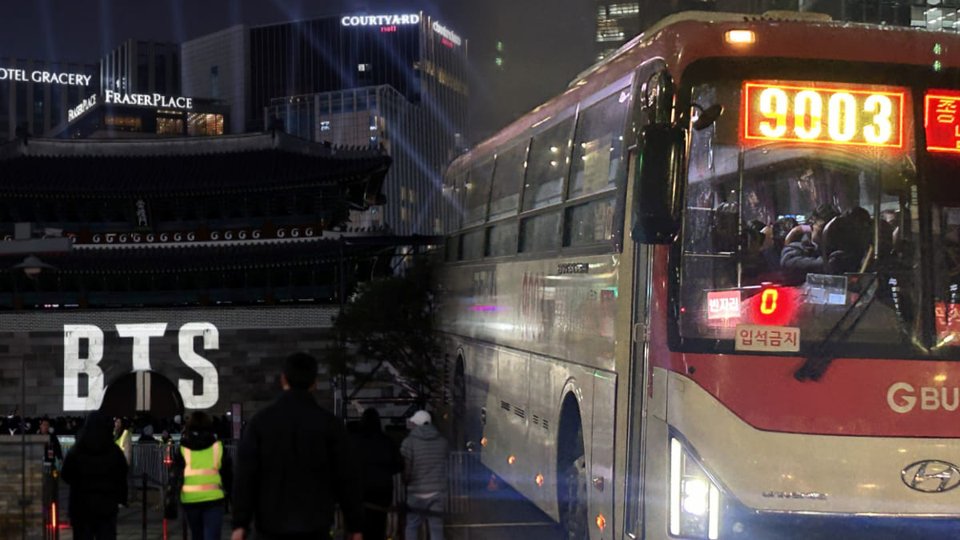
Road closures inevitably directly impact public transportation, especially bus routes. Due to the BTS performance, a total of 86 city bus, village bus, and Gyeonggi bus routes, including 33 routes passing through Sejong-daero and other major arterial roads like Sajik-ro and Saemunan-ro, were temporarily detoured. Citizens who normally used these routes had to confirm the changed paths.
A particularly important point to note is that the Gwanghwamun Station central bus lane stops (ID 01009, 01010) were bypassed by buses without stopping from the first bus on the day of the performance. This measure was reportedly taken for safety reasons, as these stops are located directly in front of the performance venue. Therefore, citizens planning to take a bus home after the performance had to move to stops located outside the controlled area, rather than their usual stops.
For efficient bus use, it was advised that the fastest method was to walk to stops located outside the venue, such as Jonggak Station, Euljiro 1-ga Station, or Anguk Station, and board there. Furthermore, checking real-time bus locations and detour routes was crucial. Major map and public transportation apps like the Seoul Public Transportation app, Naver Map, and Kakao Map provided 'Detour Information' notices for each stop, allowing users to check updated information. This real-time information check greatly helped reduce unnecessary confusion and facilitate quick travel to destinations.
4. Public Transportation Normalization and Increased Services After the Performance
After a large-scale event concludes, an unprecedented level of congestion can occur as numerous people attempt to return home simultaneously. The Seoul Metropolitan Government meticulously adjusted its public transportation operation plans to prepare for such a situation. In particular, the timing of bus route normalization and plans for increased subway services were key measures to help citizens return home safely and quickly.
For bus routes, although the performance was scheduled to end around 9 PM, road controls continued until 11 PM to ensure the safe exit of attendees and the removal of facilities. Accordingly, bus routes on the Sajik-ro and Saemunan-ro sections began to sequentially return to their normal routes starting at 11 PM. Citizens returning home late were advised to refer to this timeframe when planning their bus travel. However, as the Sejong-daero section remained closed until the early hours of the next day, buses passing through that section continued to operate on detours.
Subways were utilized as a primary means of crowd dispersion. The Seoul Metropolitan Government added 12 temporary trains to Subway Lines 2, 3, and 5, increasing services by a total of 24 times. These lines were expected to be heavily used by many citizens as they connect to Gwanghwamun or function as major transfer hubs. However, it was also announced that if station congestion became extreme, trains might bypass certain stations without stopping for public safety. Therefore, when using the subway, it was important to follow the instructions of on-site staff and check real-time congestion levels via apps.
5. Transportation Methods and Precautions for a Safe Return Home
In situations where a large crowd moves simultaneously, even minor carelessness can lead to major accidents. The Seoul Metropolitan Government prioritized citizen safety by restricting the use of certain transportation methods around the performance venue and recommending specific modes of travel. These guidelines aimed to reduce congestion and help everyone return home safely.
Specifically, the operation of 58 Ttareungyi rental stations within 1km of the performance venue was temporarily suspended. Additionally, the entry of personal mobility devices (PMs) such as electric kickboards into the vicinity of the venue was strictly restricted. This measure can be understood as an effort to prevent safety accidents that personal mobility devices might cause amidst large crowds and to secure space for pedestrians. Therefore, it was necessary to be aware in advance that these modes of transportation would not be available after the performance.
The safest and most efficient method for returning home was advised to be walking followed by public transportation transfer. After the performance, it was recommended to safely walk towards Jonggak Station or Euljiro 1-ga Station, following the instructions of on-site staff, and then use the subway or normally operating buses from there. Moving away from the congestion near the venue to a relatively less crowded outer station was known as a wise way to reduce unnecessary waiting times and return home safely. Seoul City officials urged attendees to take their time and use nearby outer stations or bus stops when returning home, as up to 300,000 people were expected to gather.
6. What Citizens Should Know When Attending Large-Scale Events
Large-scale events like the BTS Gwanghwamun live performance offer cultural enjoyment but also demand deep consideration for urban infrastructure and public safety. This case provides important guidelines on what citizens should be aware of and prepare for in advance if similar large-scale events are held in downtown Seoul in the future.
The most crucial aspects are prior information verification and flexible response capabilities. It is advisable to get into the habit of checking traffic control sections, public transportation detour and increased service information, and emergency contact networks well before the event. Furthermore, on-site situations can change at any time, so listening to real-time traffic information apps or the instructions of on-site staff and flexibly adjusting travel plans enables safe and efficient movement. Especially in crowded places, prioritizing personal safety and showing consideration for others to avoid causing inconvenience is important civic consciousness.
As seen in the case of this BTS performance, the Seoul Metropolitan Government is making various efforts to manage large crowds and ensure public safety. Increased subway services, bus route adjustments, and restrictions on personal mobility devices are all measures aimed at ensuring citizens' safe and pleasant participation in events. InfoVibe will continue to compile such useful information to assist citizens in their daily lives. We conclude by re-emphasizing that "a relaxed mindset and thorough preparation" are most important when participating in large-scale events.
This content is general information compiled based on publicly available data. For accurate details, please refer to the official announcements of relevant organizations.