Suspect Kim So-young in Gangbuk Motel Serial Murder Case: Controversy Over Prison Letter and Summary of Key Trial Details
인포바이브 편집팀|입력 2026.03.25 10:00|0
사진 출처: 서울북부지검 / 온라인 커뮤니티
Understanding the Background of the Gangbuk Motel Serial Murder Case
The 'Seoul Gangbuk Motel Drug-Related Serial Murder Case,' which recently shocked our society, is a serious crime involving multiple victims. It is known that the suspect approached victims using specific drugs, extorting money or leading to their deaths. The severity and brutality of the case deeply shocked the public and sparked social discussions on crime prevention and recurrence.
Kim So-young, identified as the suspect in the case, was arrested and indicted on the 19th of last month on charges of causing the deaths of two people and injuring one using drug-laced beverages. Subsequently, during the police investigation, three additional victims were identified, leading to further charges such as aggravated assault. Given the multiple victims and the brutal nature of the crimes, the case inevitably drew significant public attention.
The use of drugs as a method of crime is particularly concerning as it leaves victims vulnerable to exposure. This type of crime makes it difficult for victims to resist and can complicate the securing of clear evidence after the incident, thus requiring thorough investigation by law enforcement agencies.
The Prison Letter at the Center of Controversy: What Does It Contain?
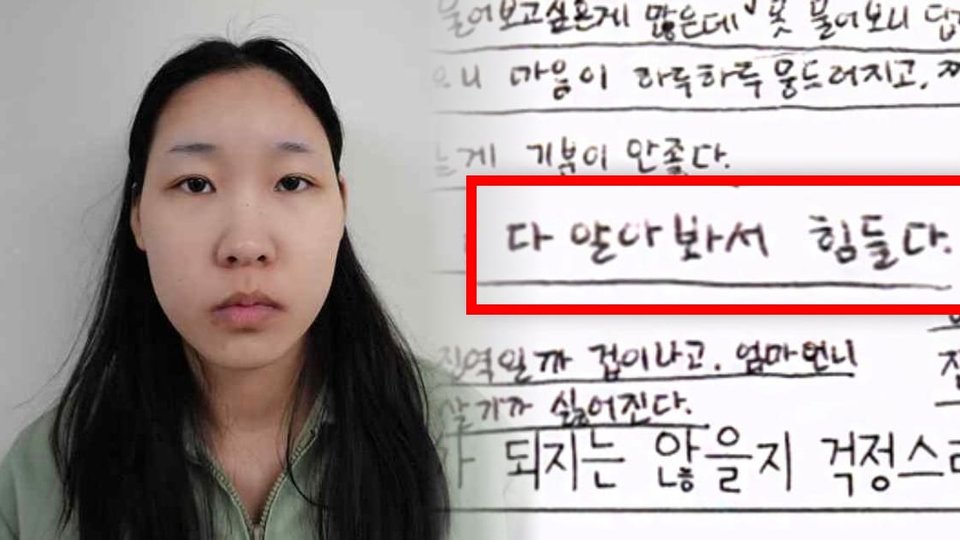
Recently, the contents of a prison letter, believed to have been written by Kim So-young while incarcerated at the Seoul Detention Center, were disclosed through an online community, igniting another wave of controversy. Along with photos of the five-page handwritten letter, a post claiming to have sent a letter to Kim and received a reply drew significant attention to the letter's authenticity and content. While it has not been definitively confirmed if the letter is indeed Kim So-young's handwriting, the attached envelope photo clearly showed the inmate mailing address of the Seoul Eastern Detention Center and the name Kim So-young.
The letter is noteworthy as it contains Kim's current psychological state and her stance on the case. The letter's author expresses distress over her situation, stating, “The media coverage is overwhelming and distressing,” and “It’s hard because my personal information has been disclosed, and everyone recognizes me.” This once again brings to mind the complex issue between the social impact of disclosing a criminal's identity and the individual's suffering.
Furthermore, the letter mentions past trauma, revealing a psychological state where she states, “If I had just died then (when I was assaulted by my father), I wouldn’t have this pain, and it would have been more comfortable.” This offers a glimpse into Kim's complex inner world and the shadow of personal suffering underlying the crime. However, at the same time, she shows fluctuating emotional changes, saying, “I’m scared to die here. Being separated from my family, my heart aches and tears apart day by day,” suggesting an unstable psychological state.
The Suspect's Account of the Crime and the Battle for Truth
In her prison letter, Kim So-young claimed that some of the details about her crimes reported by the media were untrue. She reportedly strongly denied that she first approached the victims via social media or that giving them drugs was a premeditated crime. This contradicts the motives and circumstances of the crime identified by investigative agencies and the facts known to the public, making it a crucial point of contention in the upcoming trial.
While the letter conveys an apology to the victims and their families, stating, “I am sorry. I know it’s natural that I cannot be forgiven. I will live in lifelong repentance,” it also reveals attempts to justify her actions. Kim claimed she administered the drugs because she was too scared, recalling past experiences of sexual assault, appearing to evade or mitigate responsibility for her crimes. Such claims could be perceived as secondary victimization by the victims and may draw significant social criticism.
The process of uncovering the truth of the crime and verifying the suspect's claims will unfold intensely in court. Clear evidence regarding the suspect's psychological state, motives, and the actual process of the crime is expected to be a crucial basis for judgment in the trial. Attention will be focused on how the victims' testimonies and the investigative agencies' evidence will contrast with the suspect's claims.
Identity Disclosure, Human Rights, and Social Responsibility
Kim So-young's plea of distress over the disclosure of her personal information in her prison letter has once again brought to the forefront the social debate surrounding the disclosure of violent criminals' identities. While positive aspects such as ensuring the public's right to know, crime prevention effects, and protection of potential victims are emphasized, concerns about human rights violations of suspects, harm to their families and associates, and the possibility of private retaliation are also raised.
In South Korea, the disclosure of violent criminals' identities is permitted under the Act on Special Cases Concerning the Punishment of Specific Violent Crimes. This is decided only when necessary for the public interest, considering the brutality and seriousness of the crime. In Kim So-young's case, her identity was reportedly disclosed in accordance with such social consensus and legal procedures.
While there is a view that identity disclosure can exert psychological pressure on criminals and contribute to preventing recidivism, there are also cases, like Kim's letter, where individuals express suffering due to such disclosure. Thus, identity disclosure lies at the intersection where complex social values and individual rights clash, making it an important issue that requires a balanced perspective.
The Upcoming First Trial: Its Significance and Outlook
Kim So-young's first trial is scheduled to be held on the 9th of next month at the Seoul Northern District Court. This initial trial will mark the beginning of a crucial legal process to uncover the full details of the case and determine the suspect's guilt or innocence. It is expected that the prosecution's efforts to prove the charges and the defense's arguments will unfold intensely.
Role of the Prosecution: The prosecution will focus on proving Kim So-young's charges based on evidence secured during the investigation and victim testimonies, and clearly establishing the motives and circumstances of the crime. Particularly, the premeditation of drug use and the proof of charges related to additional victims are expected to be key points.
Defense Arguments: Kim So-young's side may deny some charges or attempt to mitigate her sentence by presenting extenuating circumstances for the crime's motives, based on the claims revealed in her prison letter. Specifically, past trauma or a state of psychological instability could be included as major points in the defense.
Trial Proceedings: After the first trial, multiple hearings will follow, and a verdict will be reached through processes such as witness examination, evidence review, and final arguments. In this process, the suspect's statements, the credibility of evidence, and legal interpretations will play crucial roles.
This trial will go beyond a simple criminal case, serving as an opportunity to once again highlight the seriousness and social impact of drug-related crimes. Furthermore, it carries the societal hope that justice will be served and healing will begin for the victims.
This content is general information compiled based on publicly available data. Please refer to official announcements from relevant authorities for accurate details.